How Far Should Commercialisation Go? What Hydration Breaks Tell Us About Sport's Next Big Test
July 17, 2026
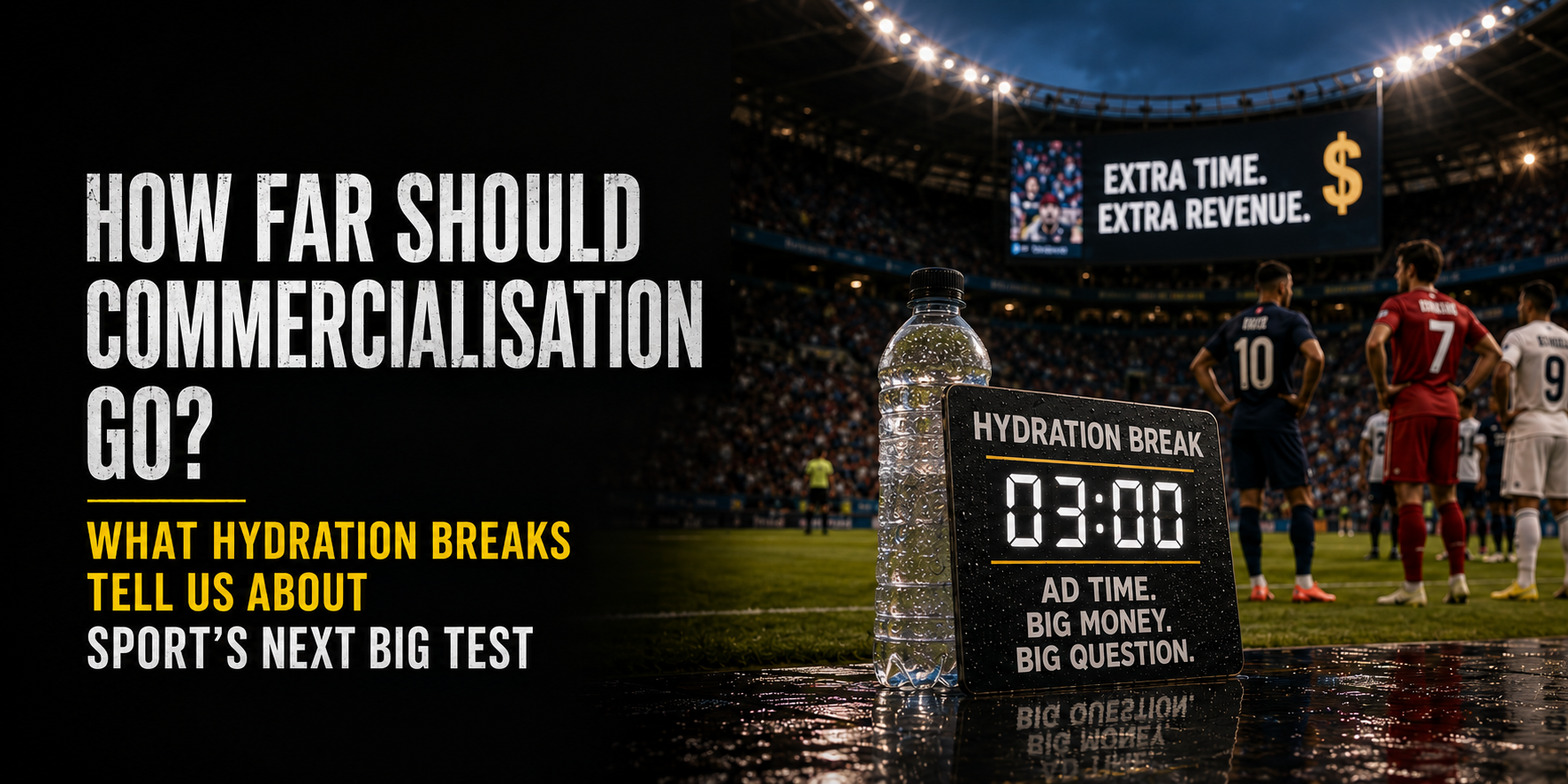
Every World Cup leaves a legacy. Usually it''s a goal, a moment, a story that gets replayed for decades. This summer, I fear that it''s the off the field antics that will continue to steal a lot of the headlines. I was reading a great article by sports business reporter Oliver Browning writing for talkSPORT, discussing the lasting impact of hydration breaks, and it got me questioning, how far is too far when it comes to commercialising sport? (Oliver''s original article is here: https://talksport.com/football/world-cup/4414927/hydration-breaks-leagues-europe-premier-league-bundesliga-la-liga/)
FIFA introduced the three-minute pauses partway through each half, ostensibly for player welfare in the heat, that''s what we were told at the beginning of the tournament. But very quickly it has become evident that the decision to break up what has always been two uninterrupted halves had other motives outside of player safety. We all hate these breaks, fans, players and coaches alike. It disturbs the momentum of the game and disrupts play at key moments. Football is a game of momentum and attrition that is designed to be played in halves. Can one team sustain the energy to keep attacking whilst the other maintains concentration when defending their penalty area, 45 minute halves are fundamental to how the game is played. When you break up play, it alters the experience and flow of the match. Browning''s reporting lays out the commercial reality behind the new pauses in play: those breaks have created an extra four minutes and 20 seconds of ad space per game, adding up to over seven hours of additional advertising across the tournament. In the US, where a single 30-second slot on Fox Sports can cost up to $750,000 in the closing stages, that''s an estimated $250m in new revenue. More than half of what Fox paid for the English-language broadcast rights in the first place.
That is a staggering amount of cash. And scarily, a strong business case for leagues to use moving forward.
And business cases have a habit of travelling. Browning reports that MLS and NWSL are already being tipped as the most likely leagues to adopt hydration breaks permanently, with La Liga potentially following given its focus on the US market. The Premier League, propped up by its own broadcast strength, is described as the "last place to adopt a change." For now.
The real question isn''t whether it will happen. It''s how far we let it go.
This is where I think sport, and the brands and rights holders around it, need to pause and ask a harder question than "how do we monetise this?". The question should be: what are we willing to sacrifice from the product itself to get there?
There''s a meaningful difference between commercial innovation that sits alongside the game and commercial innovation that interrupts it. Shirt sponsors, stadium naming rights, perimeter boards, even half-time content, these all coexist with football without changing what happens between kick-off and full-time. Hydration breaks are different. They stop the game. They change the rhythm supporters have understood for over a century. And they do it explicitly because stopping the game is worth more money than letting it flow.
One media executive quoted by Browning called this "found money," a captive audience reached during the most important moments of the match. But found money for whom? Not the fan who paid for a ticket, a subscription, or simply their attention. The value being unlocked here is being extracted at the direct expense of the experience the audience is actually paying for.
Partnership before disruption
If I''m advising a football club, a governing body, or a brand looking to get closer to the game, my starting point is always the same: work out how you add value to the experience before you look at how you can interrupt it for revenue. There is enormous, still largely untapped commercial opportunity in content, storytelling, community and genuine partnership activation that never requires stopping a match. Brands that get this right, that find ways to be additive rather than intrusive, tend to build far more durable relationships with fans than those chasing short-term inventory.
The hydration break debate is really a proxy for a much bigger conversation the game is going to keep having: as broadcast revenues plateau in some markets and rights holders look for new levers, how much of the product itself becomes negotiable? Once you''ve shown the market that interrupting the game is monetisable, as one rights executive told Browning, it becomes a "stalking horse" for further commercial creep elsewhere. Don''t even get me started on the potential 30 minute World Cup Final half-time show that''s being touted (let''s save that for next week)!
Sport doesn''t need to choose between commercial growth and protecting what makes it worth watching. But it does need to be deliberate about the order of operations. Partnership and value creation first. Disruption only as an absolute last resort, if ever.
The clubs and brands that understand that distinction will be the ones fans still trust in ten years.
Thanks to Oliver Browning at talkSPORT for the original reporting and figures that this piece is built on.
← Back to all articles